Think Different – The Puffin Browser Odyssey
Prologue: At the Crossroads of Software Innovation
Dr. Shioupyn Shen, an early Google engineer, founded CloudMosa in 2009. Google had launched both Android and Chrome in 2008, and with its extraordinary engineering talent and vast financial resources, there was little doubt that these platforms would achieve market dominance. Yet something was missing. They lacked the kind of breakthrough "WOW" moment that defined the iPhone's debut in 2007.
At that crossroads, Google faced two strategic options: Outspend Competitors with the old architecture or Outsmart Competitors with a new architecture. Google chose the former to accelerate market adoption. Dr. Shen chose the latter and founded CloudMosa to pursue a radically new “Security First” vision through Puffin Browser.
A Radically New Software Architecture
Puffin was a game-changer in software architecture. Instead of running a single monolithic program on the device, Puffin split a browser into two distinct halves. The 1st half, running on the client side, handles Display Rasterization, which accounts for only 5% of the workload. The 2nd half, running on the server side, handles HTML Rendering, which accounts for the remaining 95%.
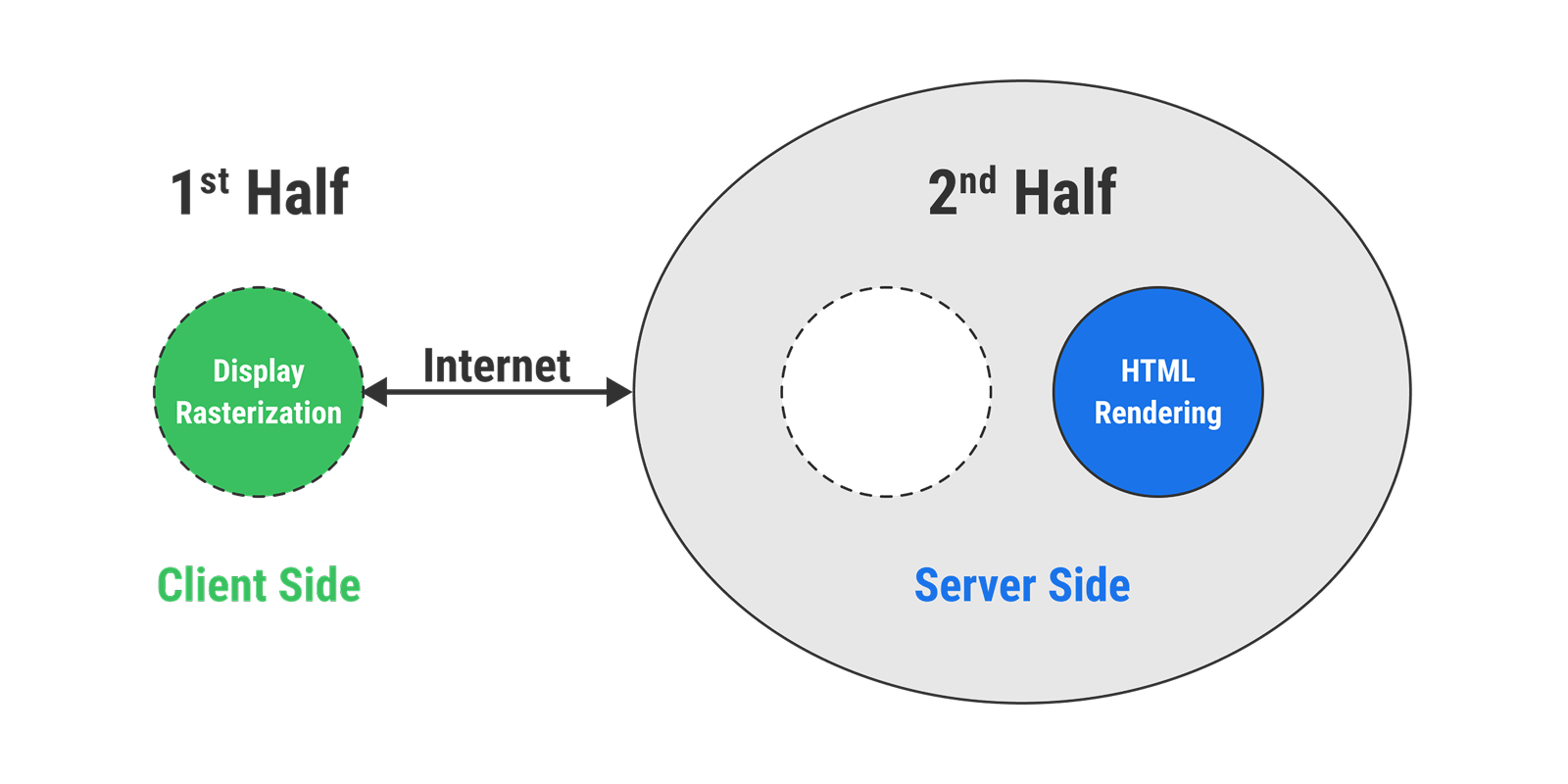
Launched in 2010, Puffin was the first web browser based on Network Vector Rendering (NVR) with built-in Remote Browser Isolation (RBI). Puffin pioneered the concepts of NVR and RBI nearly a decade before followers coined the terms. Puffin tackled two major software challenges simultaneously: Performance and Security. More precisely, mobile performance in the early days and desktop security in recent years.
Cloud Offload: Performance Arbitrage to Create the Fastest Mobile Browser
On the client side, early mobile devices had limited processing power, yet it was more than sufficient when the workload could be reduced to less than 5%. On the server side, cloud servers had virtually unlimited computing resources, far exceeding the fastest desktops. This Split-Browser architecture offloaded the heavy lifting to the cloud, giving Puffin a decisive performance advantage. Puffin, as the fastest mobile browser money could buy, was an instant hit and became the #1 paid app on iPad in the early 2010s.
Puffin could extend the lifespan of mobile devices, making them nearly future-proof. However, the hardware industry had a vast interest in “planned obsolescence” to retire mobile devices as often as possible. Just like the “Great Lightbulb Conspiracy” of 1924, Apple sabotaged Puffin’s business after Steve Jobs' passing. Rest in peace, Think Different.
Cloud Isolation: Security Arbitrage to Create the Most Secure Desktop Browser
Money can buy performance, but money alone can’t buy security. Display Rasterization on the client side is a small, strongly fortified bastion host designed to be virus-resistant. HTML Rendering on the server side contains a large, complex feature set and is naturally virus-susceptible. Bugs that lead to viruses are orders of magnitude more likely to reside on the server side than on the client side. If PostScript is the server-to-client data exchange format, server viruses can’t sneak through the “PostScript Air Gap” to reach the client. This split-browser architecture can largely eliminate Zero-Day Viruses, making Puffin nearly virus-proof. Additionally, in this security-first paradigm, “the Jump Box is the Sandbox” concept applies to almost all software applications, not just web browsers.
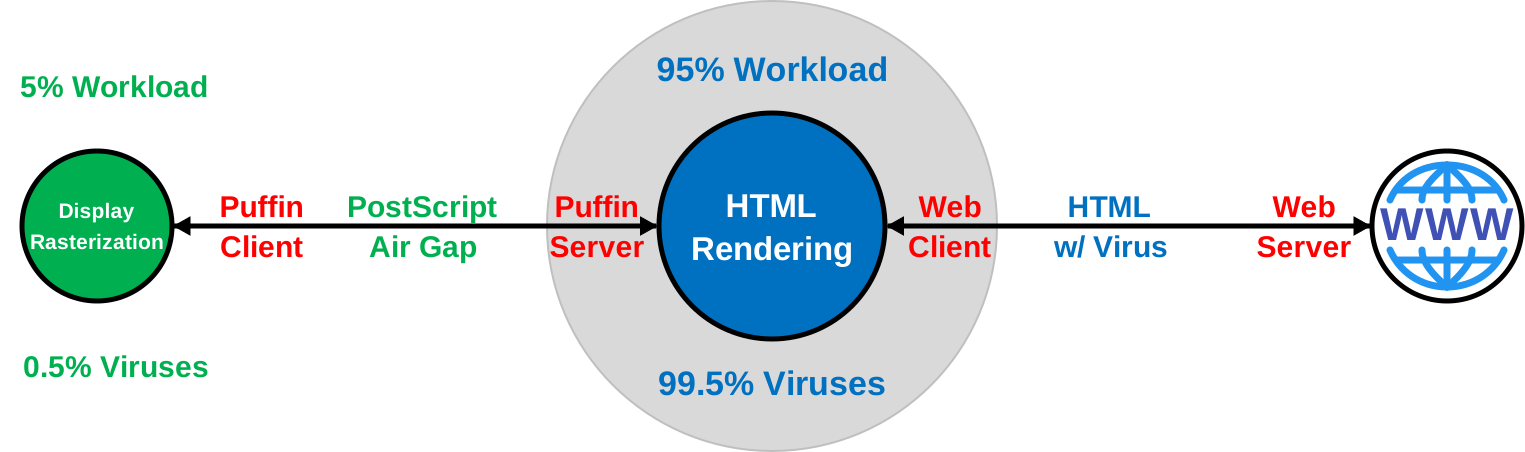
Over the years, Puffin has accumulated over 200 million downloads across platforms. Puffin has never been compromised by viruses in its 15 years of operation. Meanwhile, thousands of zero-day vulnerabilities fixed in Chrome weren't even virus-worthy on Puffin.
AI-Assisted Hacking: The Arrival of the Cybersecurity Ice Age
https://blog.google/security/chrome-stronger-with-every-update/
On July 30, 2026, Google published an article titled “Stronger with every update: How we’re making Chrome and the web safer in the AI Era”.
The article features a chart showing a dramatic increase in the number of bugs fixed by Chrome Stable releases over the past two years. The release cycle is once every 4 weeks.
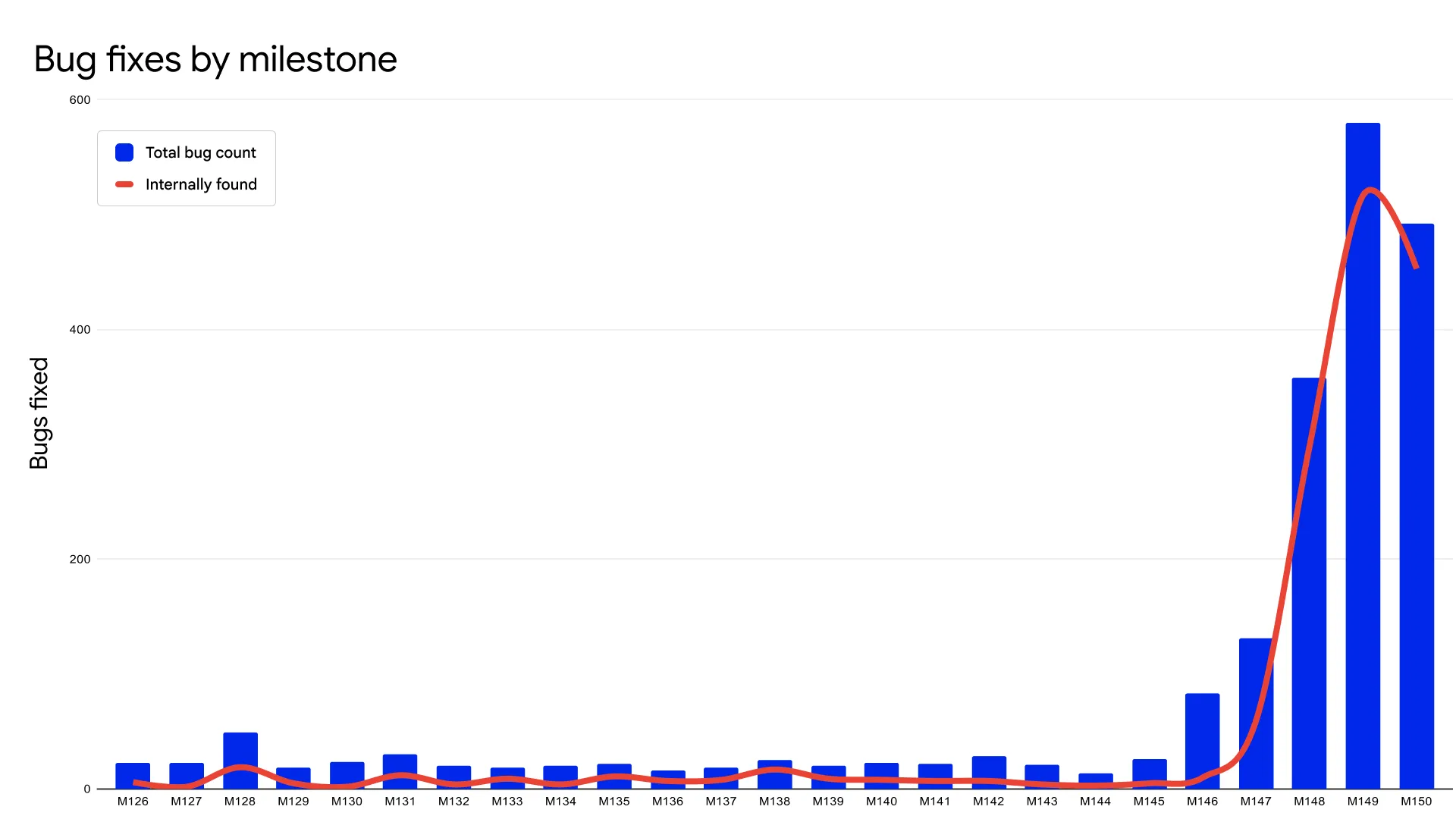
According to the chart, the volume of bug fixes has increased twentyfold recently. Google frames the AI Era as “the best of times” for Chrome, when many more bugs are fixed each month now than just a few months ago. As increasingly capable AI-assisted hacking tools become widely available, hackers, foreign and domestic, criminals or not, will discover far more bugs in Chrome than Google can identify and fix. The AI Era, in fact, is “the worst of times” for Chrome, when the attackers can decisively overrun the defenders.
Many enterprise security providers rely on Chrome for their underlying security foundation. It is risky to “Stand on the Shoulders of Giants” without a contingency plan. What if AI fundamentally disrupts Chrome’s endpoint security within the next six months? Puffin was built to address that exact possibility. The prudent response isn’t to predict if Chrome will kneel to AI. Instead, it’s to have a backup plan in place before failure turns into disaster.
Epilogue: What If Browsers Were Fast and Secure?
Apple bullied Adobe Flash to death, literally. Apple argued that Flash was bloated, buggy, and unworthy of the iPhone. If Apple’s Safari had incorporated Puffin’s Split-Browser technology, both concerns could have been addressed. With the Split-Browser architecture, Cloud Offload would have solved the performance burden, and Cloud Isolation would have solved the security shortcomings.
Supporting users to play Flash content on iPad demonstrated Puffin’s strategic importance. It helped iPad win the K-12 market in the 2010s because most educational content was developed on Flash. Dr. Shen's daughter, studying at Penn Medicine, received an iPad from UPenn to access interactive Flash content professors created for decades. When Apple kicked Puffin off the iPad, the competitive landscape shifted from iPad to Chromebook. As a result, Apple lost the K-12 education market to Google, and iPad sales have never recovered since.
Adobe Flash, as a bullied victim, committed suicide in the end. There was nothing truly wrong with Adobe Flash. The wrongdoing was the bully who couldn't handle Adobe Flash. Unfortunately, “You can’t handle the truth!” is the ugly truth. Rest in peace, Adobe Flash. Wish this tragedy never happens again.
Think Different is an Odyssey. Those who coined the Think Different slogan couldn’t always live up to its idealism. Yet, it inspired new generations to pick up the mantle. After all, Odyssey was mainly about the difficult journey rather than the final glory.